
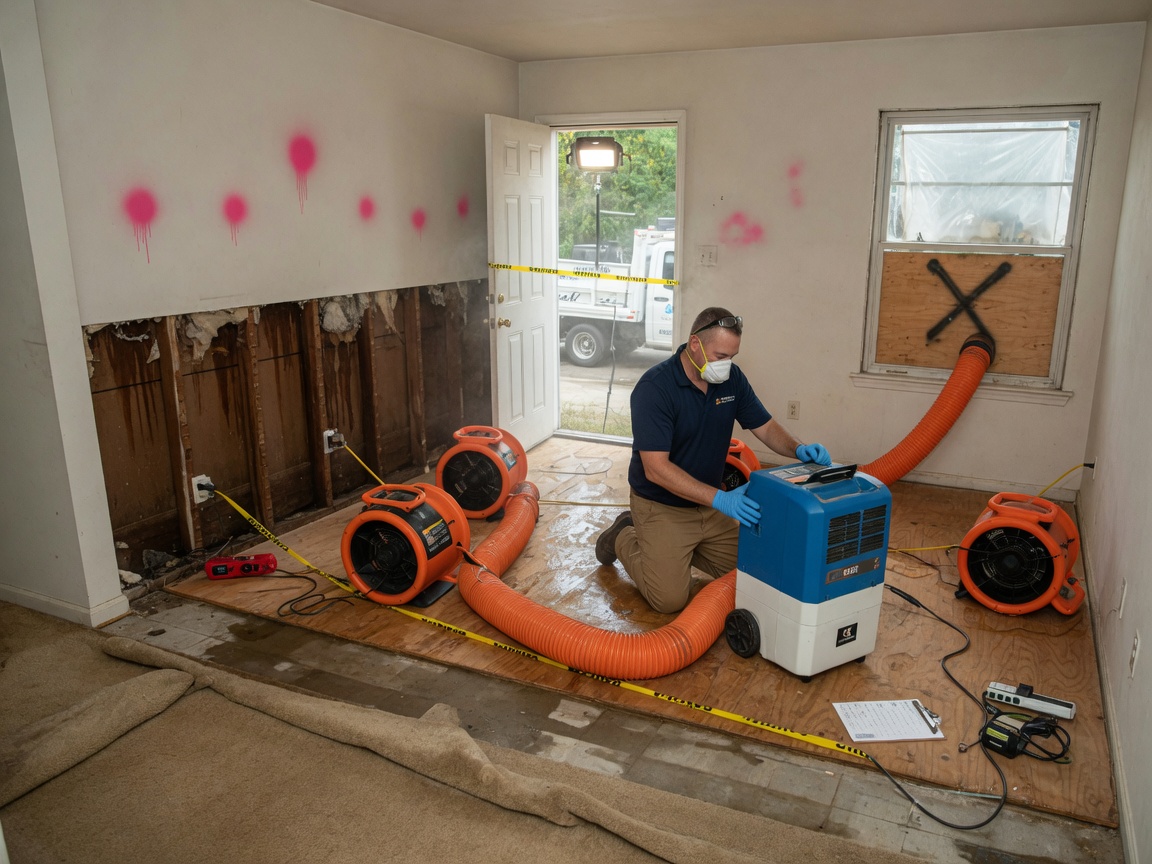
Houston's subtropical climate with hot humid summers keeps moisture trapped longer in slab-on-grade homes common throughout Harris County after water intrusion along I-10 or TX-288. Structural drying crews must run high-capacity dehumidifiers and air movers for extended periods because ambient humidity near the Medical Center and Minute Maid Park prevents quick evaporation that occurs in drier parts of Texas. Older housing stock near the Houston Zoo frequently sees hidden saturation in wall cavities and subfloors following heavy rains, where standard drying fails and leads to mold if airflow is not forced through every layer.
Structural Drying in Houston — What We Handle
- ✓Extended equipment runtime required by persistent Gulf humidity versus inland Texas markets
- ✓Slab foundation access points demand targeted drying that differs from crawlspace homes elsewhere
- ✓Rapid mobilization along I-45 and I-69 corridors to beat secondary damage in dense urban blocks
Structural Drying Services We Offer in Houston
✓Moisture Mapping and Assessment
We scan walls, floors, and ceilings with meters and thermal cameras to chart every wet area before equipment goes in.
✓Cavity and Wall Drying
Specialized injectors and directed airflow pull moisture from behind drywall and inside stud bays common in Carrollton homes.
✓Subfloor and Hardwood Drying
We use mats and low-profile air movers to dry hardwood and plywood subfloors without cupping or delamination.
✓Slab and Foundation Drying
Targeted dehumidification and perimeter fans remove moisture from concrete slabs after foundation leaks or storm runoff.
✓Daily Moisture Monitoring
Technicians return each day to log readings and adjust equipment until materials reach safe dry standards for the local climate.
In Carrollton neighborhoods like Old Town Carrollton and Indian Creek, many homes built before 1990 contain plaster walls and hardwood subfloors that trap water differently than modern drywall. After severe storms common in Dallas County, water migrates into cavities behind baseboards and under vinyl plank flooring. We use moisture meters and thermal imaging to locate saturation points that standard fans miss, then place air movers and dehumidifiers in patterns that match the home's layout and the season's high humidity levels.
Mild winters in North Carrollton and Trinity Mills still allow pipe bursts that soak insulation inside exterior walls. Structural drying here requires monitoring daily moisture readings because the area's clay-heavy soil slows natural evaporation and keeps crawl spaces damp longer. We adjust equipment run times when humidity spikes during summer storms, preventing secondary damage to electrical boxes and HVAC returns that sit low in many Carrollton ranch homes.
How It Works in Houston
- 1
Initial Inspection
We walk the property, test affected materials, and identify hidden moisture paths in walls and under floors.
- 2
Water Extraction
Standing water is removed first so drying equipment can focus on absorbed moisture in building materials.
- 3
Equipment Setup
Air movers, dehumidifiers, and cavity tools are placed according to the moisture map and home layout.
- 4
Monitoring And Completion
Daily checks continue until moisture levels stabilize, then equipment is removed and the site is cleared.
Serving All of Houston
We regularly handle structural drying jobs near:
- 📍Houston Zoo
- 📍Museum of Fine Arts
- 📍Space Center Houston
- 📍Minute Maid Park
Structural Drying Pricing in Houston
Cost depends on square footage affected, depth of saturation, and number of days equipment must run.
Want the full picture of this service? See our Structural Drying page, or everything we do in Houston, TX.