
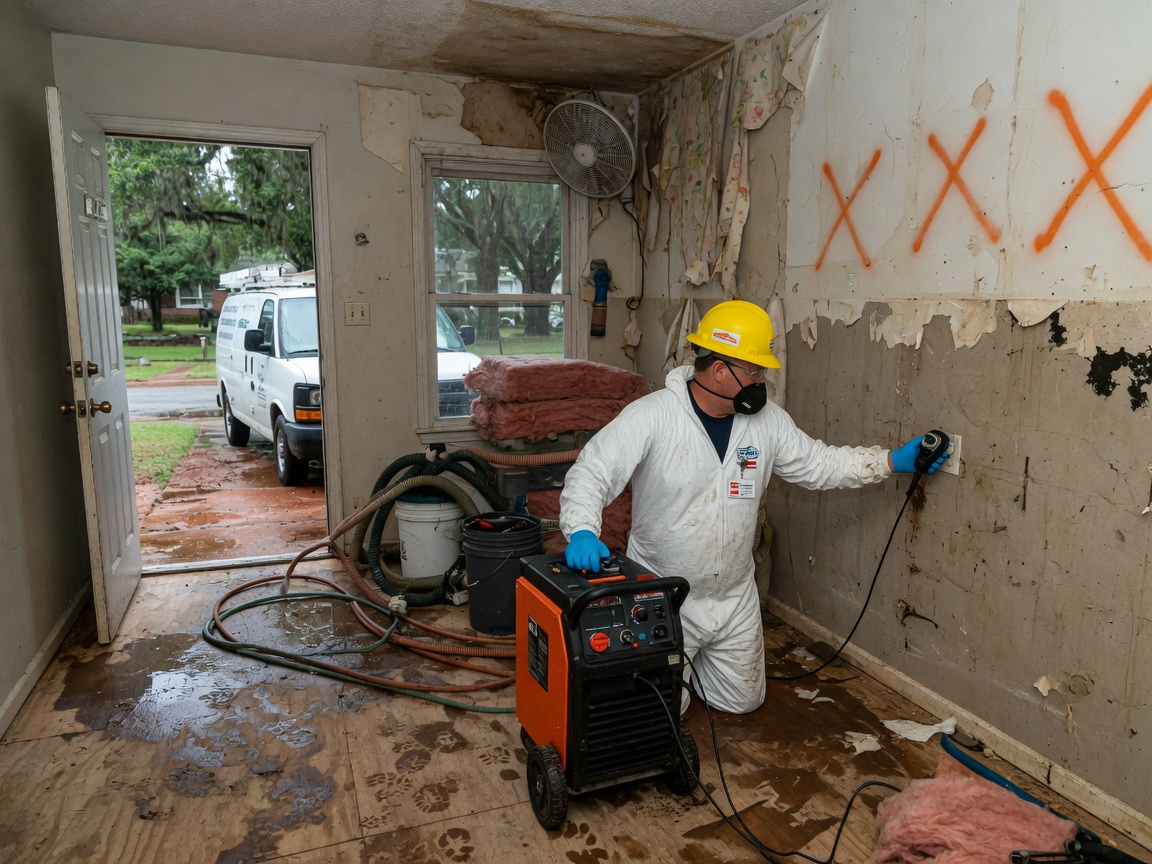
Mission sits in Hidalgo County beside the Rio Grande, where river-adjacent homes and irrigation-fed citrus groves face repeated water intrusion after summer downpours. Properties along US-83, TX-107 and FM-492 often suffer slab-edge seepage or crawl-space flooding that travels through the area's sandy soils. Older houses near the Mission Historical Museum and Sharyland Plantation require targeted drying to prevent mold in walls that stay damp through the region's mild winters.
Flood Restoration in Mission — What We Handle
- ✓Restoration crews must coordinate with local drainage districts along the Rio Grande levees rather than standard municipal pumps.
- ✓Drying times lengthen in the hot semi-arid climate when humidity from the river slows evaporation inside stucco and masonry homes.
- ✓Work near Bentsen-Rio Grande Valley State Park demands extra containment to protect adjacent wildlife habitat from equipment runoff.
Flood Restoration Services We Offer in Mission
✓Storm Flood Extraction
Rapid removal of rainwater and runoff from living spaces after severe storms that hit Carrollton and nearby Dallas areas.
✓Basement and Crawlspace Drying
Targeted drying of below-grade spaces common in older Indian Creek and Old Town Carrollton homes where clay soil retains water.
✓Sewage Backup Restoration
Full removal and disinfection of contaminated water from overloaded municipal drains during heavy rainfall events.
✓Structural Moisture Mapping
Meter readings and thermal imaging to locate hidden saturation in walls and floors without guesswork.
✓Post-Flood Mold Containment
Immediate containment and HEPA filtration to stop mold growth triggered by lingering humidity after Carrollton storms.
✓Flooring and Subfloor Restoration
Removal and replacement of water-damaged hardwood, laminate, and carpet in flood-affected rooms.
Carrollton sees repeated flooding when heavy spring and summer storms dump water faster than the Trinity River tributaries and local drainage can handle. Homes in Old Town Carrollton and Downtown Carrollton often sit on older slabs or crawlspaces that trap water against the foundation, while newer builds in North Carrollton and Indian Creek have tighter envelopes that hide moisture behind drywall and under luxury vinyl. After the water recedes, humidity levels stay high enough to push secondary damage into insulation and subfloors within forty-eight hours.
We extract standing water with truck-mounted units sized for the volume typical in Dallas County storms, then place commercial air movers and dehumidifiers calibrated for the clay-heavy soils that hold moisture longer around Josey Ranch Lake and Crosby Recreation Center. In Trinity Mills neighborhoods, we frequently open wall cavities on 1980s homes where water has wicked up behind baseboards and into HVAC returns. Every job includes moisture mapping with meters so we stop short of unnecessary demolition while still reaching hidden saturation points.
How It Works in Mission
- 1
On-Site Assessment
We arrive within hours, document all affected rooms, and test moisture levels in walls, floors, and cabinets.
- 2
Water Extraction
Truck-mounted pumps and wands pull standing water from carpets, hard surfaces, and low areas.
- 3
Drying And Monitoring
Air movers and dehumidifiers run until readings drop below saturation thresholds, with daily checks.
- 4
Final Restoration
Remove and replace damaged materials, then clear the site for normal use.
Serving All of Mission
We regularly handle flood restoration jobs near:
- 📍Bentsen-Rio Grande Valley State Park
- 📍Mission Historical Museum
- 📍Sharyland Plantation
Flood Restoration Pricing in Mission
Costs depend on water category, square footage affected, and how many rooms require wall or floor opening.
Want the full picture of this service? See our Flood Restoration page, or everything we do in Mission, TX.